


Mailchimp fits a B2B team whose email is a newsletter or promotions channel that sales never acts on. HubSpot Marketing Hub fits a team that has to show what email does for pipeline, because email, contacts, deals and reports share one CRM record. Bending Spoons agreeing on November 19, 2026 to buy Mailchimp does not change that split. It does make this a good time to check which team you are.
Key Takeaways
- Mailchimp is built to send email to audiences. HubSpot is built on one CRM record that marketing, sales and service share.
- Mailchimp bills every contact in every audience, unsubscribed contacts included. HubSpot bills seats and marketing contacts, and stores other contacts without charge.
- The two bill on different units, so price your own list on both.
- The Bending Spoons deal is signed but not closed, and no pricing or product changes have been announced.
- Choose by the job email does for your pipeline, and time the move to your renewal.
What Is the Difference Between Mailchimp and HubSpot?
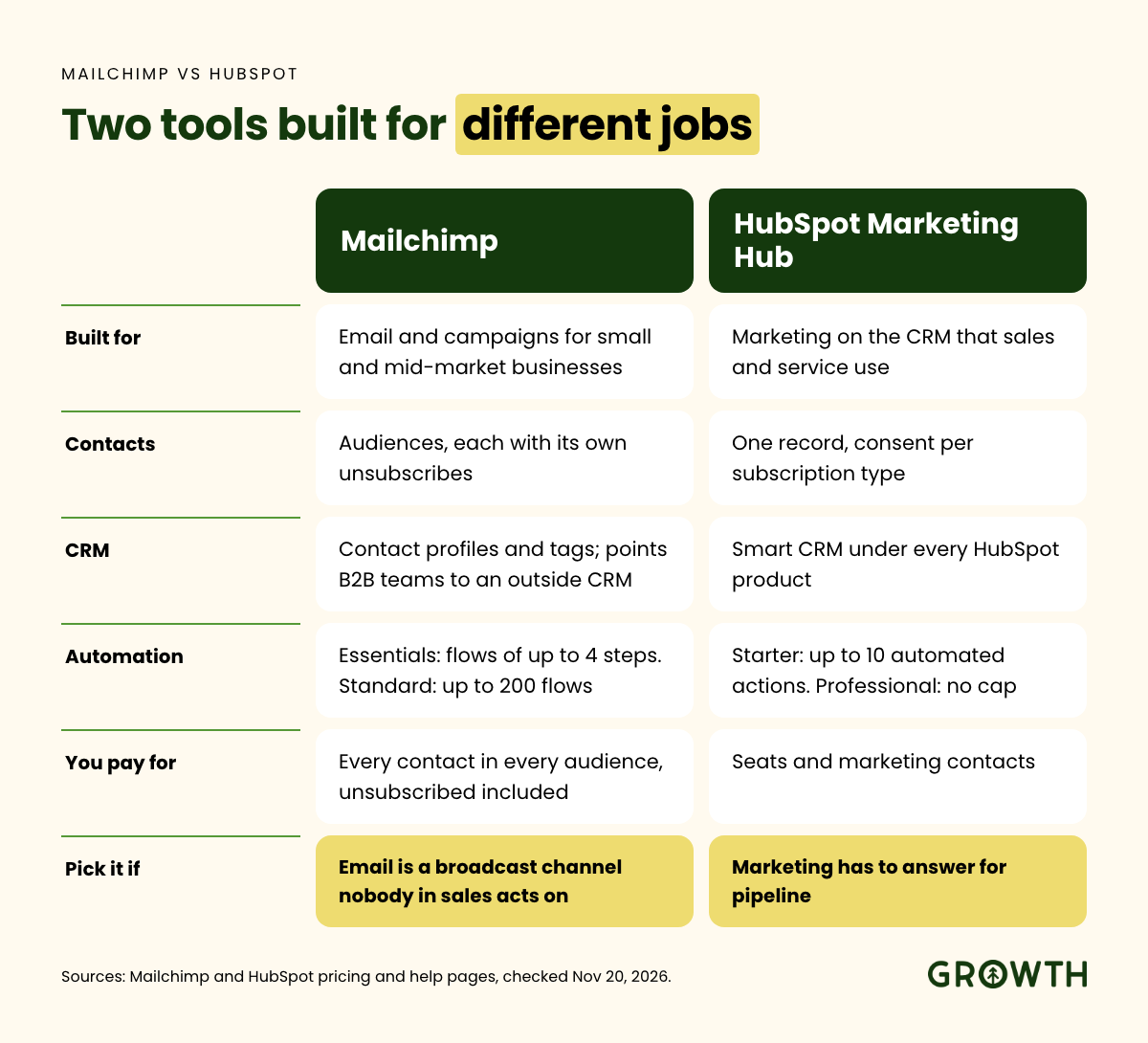
Mailchimp is an email marketing platform organized around audiences, and HubSpot Marketing Hub is a marketing platform built on the CRM that sales and service teams also use. That difference decides most of what follows.
| Mailchimp | HubSpot Marketing Hub | |
|---|---|---|
| Built for | Email and marketing campaigns for small and mid-market businesses | Marketing on the same CRM that sales and service use |
| How contacts are organized | Audiences, each with its own subscribers and unsubscribes | One contact record, with consent held per subscription type |
| CRM | Contact profiles and tags; Mailchimp points B2B teams with sales-driven needs to an outside CRM | HubSpot's Smart CRM is the database under every HubSpot product |
| Automation | Essentials: flows of up to 4 steps. Standard: up to 200 flows with branching | Starter: up to 10 automated actions. Professional: no cap |
| Email A/B testing | Standard and Premium | Professional and Enterprise |
| What you pay for | Every contact across all audiences, including unsubscribed and non-subscribed | Seats plus marketing contacts; non-marketing contacts are not billed |
| Owner | Intuit, with a sale to Bending Spoons pending | HubSpot |
When Is Mailchimp the Right Choice?
Mailchimp is the right choice when email is a broadcast channel that stands on its own: a newsletter, event announcements or promotions sent to a list nobody hands to sales. Its Standard plan includes up to 200 automation flows with branching, plus A/B and multivariate testing, and its free plan covers 250 contacts and 500 sends a month (Mailchimp pricing plans).
We have advised clients to keep Mailchimp. One kept it next to its HubSpot CRM for design flexibility. Another kept its broad newsletters in Mailchimp and moved the contacts sales works into HubSpot.
When Is HubSpot the Right Choice?
HubSpot is the right choice when marketing has to answer for pipeline. Email engagement, form fills, deals and revenue sit on one contact record, so sales sees what a prospect opened and marketing can report on which campaigns produced deals. Mailchimp's own help center says that for organizations "often those with a business-to-business focus", CRM "can be a more complex and sales-driven process", and points them to an outside CRM (Mailchimp).
In our client work, the cost of keeping email apart from the CRM shows up as manual work. Teams rebuilt custom lists by hand every week, tracked do-not-email requests outside the email tool, and lost email clicks that never reached sales. For why disconnected systems also break the forecast, read why your HubSpot forecast is always wrong.
How Do Mailchimp and HubSpot Compare on Price?
Mailchimp and HubSpot bill on different units, so compare them on your own list. Mailchimp counts every contact in every audience, including unsubscribed and non-subscribed contacts (Mailchimp). HubSpot counts seats and marketing contacts, and does not bill for contacts you store but do not market to (HubSpot).
| Plan level | Mailchimp | HubSpot Marketing Hub |
|---|---|---|
| Free | 250 contacts, 500 sends a month | Free tools: 2 users, 2,000 sends a month with HubSpot branding |
| Entry | Essentials: up to 50,000 contacts, sends up to 10 times the contact limit, 3 seats | Starter: priced per seat, 1,000 marketing contacts, sends up to 5 times the contact tier |
| Middle | Standard: up to 100,000 contacts, 12 times sends, 5 seats | Professional: from $800 a month billed annually, 3 seats, 2,000 marketing contacts, $3,000 onboarding |
| Top | Premium: from 10,000 contacts, 15 times sends, unlimited seats | Enterprise: from $3,600 a month, 5 seats, 10,000 marketing contacts, $7,000 onboarding |
Mailchimp's prices vary by region and contact count, and its pricing page offered 50% off paid plans for 12 months when we checked (Mailchimp pricing). HubSpot is moving some accounts to a seats-and-credits model in which marketing contacts are no longer billed and email sends draw on credits, so confirm which model a quote uses (HubSpot).
Cost cuts both ways in our client work. One client found that emailing its full 54,000-contact database from Mailchimp would cost far more than its current plan. Another, already on HubSpot, weighed moving to Mailchimp and a low-cost CRM to save money.
What Does the Bending Spoons Deal Change for Mailchimp Customers?
Nothing has changed for Mailchimp customers yet. Intuit signed a definitive agreement on November 19, 2026 to sell Mailchimp to Bending Spoons for about $3.68 billion, with $3.31 billion in cash and $368 million in Bending Spoons stock, and expects the sale to close in early 2027 subject to regulatory approval (Intuit). Mailchimp told customers that no action is required and that it remains part of Intuit until the deal closes (Mailchimp).
Bending Spoons describes its model in its own filings. Its June 2026 prospectus says it has made, and expects to keep making, "at least with each acquisition, workforce reductions", and that monetization changes "may include price increases, changes to subscription tiers or plans" (prospectus). At Evernote, the team went from 341 people to 60, and the free plan was cut to 50 notes and one notebook (TechCrunch). At WeTransfer, Bending Spoons planned to cut 75% of staff (TechCrunch). Its CEO, Luca Ferrari, said Bending Spoons will "invest substantially in the business" after closing (Bending Spoons).
Growth's read: plan for change at renewal, not for an emergency. If your Mailchimp contract renews in 2027, price your list on both tools now and decide on your own timeline.
How Hard Is It to Switch From Mailchimp to HubSpot?
Moving the contacts is the fast part. HubSpot's Smart Transfer moves Mailchimp contacts and email templates into HubSpot (HubSpot). The work is in consent spread across Mailchimp audiences, the forms still feeding Mailchimp, the sending domain and rebuilt workflows. In Growth's Mailchimp migrations, the first HubSpot send went out two to four months after kickoff. Read what broke in six Mailchimp migrations.
Growth's Recommendation
Stay on Mailchimp if email is a broadcast channel and nobody in sales acts on it. Move to HubSpot when marketing has to report on pipeline or sales needs email engagement on the contact record. Make the call on your renewal date and your own list. If you are weighing more than two tools, read our guide to Mailchimp alternatives for B2B teams.
FAQs
Is HubSpot better than Mailchimp for B2B companies?
HubSpot is the better fit for a B2B company whose sales team works the same contacts marketing emails, because email engagement, deals and reports share one CRM record. Mailchimp fits a B2B company that uses email as a standalone newsletter or promotions channel. Mailchimp's help center points B2B teams with sales-driven CRM needs to an outside CRM.
Does Mailchimp charge for unsubscribed contacts?
Yes. Mailchimp counts subscribed, unsubscribed and non-subscribed contacts toward a plan's contact count, across all audiences combined. Archived, cleaned and deleted contacts do not count. HubSpot bills only the contacts set as marketing contacts, so the contacts you keep for sales or service records do not raise the bill.
What happens to Mailchimp after Bending Spoons buys it?
Nothing has changed yet. The sale was signed on November 19, 2026 and is expected to close in early 2027, and Mailchimp says customers need to take no action. Bending Spoons' prospectus says its acquisitions usually bring workforce reductions and may bring price or plan changes, and that it typically completes these changes within the first year after closing.
Can Mailchimp connect to HubSpot?
Yes, with limits. HubSpot's Mailchimp integration sends contacts one way, from HubSpot to Mailchimp, and syncs Mailchimp sends, opens, clicks and bounces onto existing HubSpot contacts every 15 minutes, with about a month of history (HubSpot). It suits a team keeping Mailchimp beside HubSpot.
How long does it take to switch from Mailchimp to HubSpot?
In Growth's Mailchimp migrations, the first HubSpot send went out two to four months after kickoff, and the contact import took less than a day. Subscription types, sending-domain changes that wait on IT, rebuilt templates and training set the pace.
Next Step
Book a 30-minute call and get a one-page diagnosis of where your email and CRM should live.
Growth is an Elite HubSpot Solutions Partner. We have moved clients from Mailchimp to HubSpot, and we have advised others to keep Mailchimp.
Prices, plans and facts checked November 20, 2026.
Sources
- Intuit: first-quarter results and agreement to sell Mailchimp: deal terms and timing
- Bending Spoons: agreement to acquire Mailchimp: the buyer's statement
- Mailchimp: Intuit enters agreement to sell Mailchimp: guidance for customers
- Bending Spoons IPO prospectus, June 2026: workforce and pricing statements, Evernote team size
- TechCrunch: Evernote free plan limits and WeTransfer staff cuts
- Mailchimp: About pricing plans and using Mailchimp with another CRM
- HubSpot: Marketing Hub pricing, marketing contacts billing and seats-and-credits migration FAQ
- HubSpot: Smart Transfer supported apps and the Mailchimp integration
Recent posts