


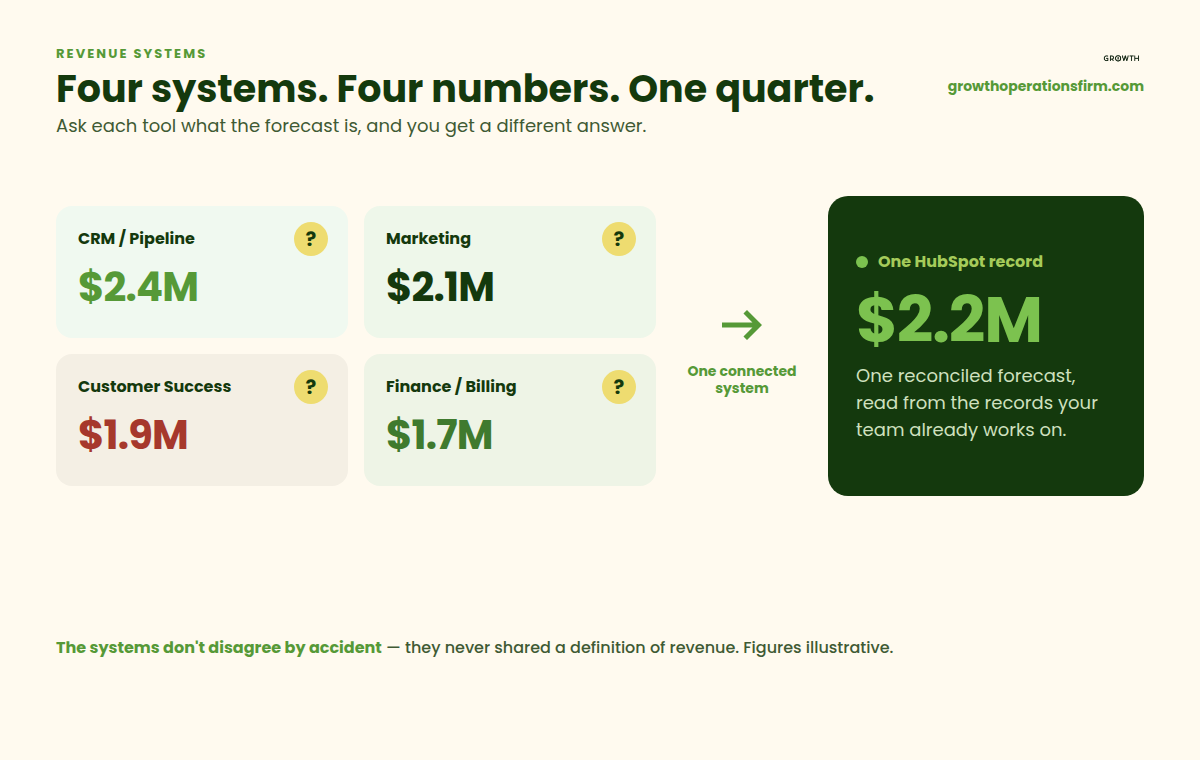
Answer summary. Your team's sales and/or revenue forecast in HubSpot is untrustworthy typically because the data behind it lives in disconnected systems that never reconcile. Ask your CRM, your spreadsheet, your billing tool, and your board deck what next quarter looks like, and you get four different numbers. The fix is one connected revenue system, which is what HubSpot Revenue Hub is built to give you.
First, one distinction worth setting up front, because it shapes everything below. Your sales forecast is what your sales team expects to close: pipeline and new bookings, owned in the CRM. Your revenue forecast is the bigger number the business will actually recognize and collect — those bookings plus renewals, expansion, billing, and churn, owned across sales, customer success, and finance. The two are not the same. A sales forecast can look clean in the CRM while the revenue forecast still breaks, because the revenue number spans systems the CRM never sees. This piece is about that revenue forecast — the one your board actually holds you to.
Why can't you trust your revenue forecast?
You can't trust it because no single system owns the whole number. Your sales forecast can look clean in the CRM, but the revenue forecast is a different animal. Sales pipeline lives in the CRM, renewals live with customer success, and cash lives in finance, so the revenue number is assembled by hand from three or four sources that rarely reconcile. Each source is right locally and wrong in aggregate.
Forecast distrust is the norm, not the exception. In HubSpot's 2026 State of B2B Revenue Report, 78% of revenue leaders say they spend a significant amount of time every month reconciling revenue data just to make the number line up.
The raw picture is incomplete before you even start. Salesforce's State of Sales research finds sales leaders estimate 19% of their company's data is inaccessible, which limits the visibility a forecast depends on. The cause is structural: the number is a stitch of exports and estimates, and every seam is a place it can tear.
The four systems where your number fractures
Most mid-market revenue teams run at least four systems that each hold part of the forecast: the CRM for pipeline, marketing automation for demand, customer success for renewals and churn, and finance or billing for what actually gets paid. And four is the floor, not the ceiling — plenty of teams also run a separate quoting/CPQ tool and a contract system between the CRM and billing, and each one is another seam where the number slips (it is no accident that quote-to-cash is exactly what HubSpot Revenue Hub pulls back onto one record). The table below shows what each one knows and what it distorts.
| System | What it knows | Where it distorts the forecast |
|---|---|---|
| CRM / Sales pipeline | Open deals, stages, expected close dates | Optimistic close dates; committed and best-case blur together |
| Marketing automation | Lead volume, source, campaign influence | Often counts pipeline that sales has not accepted yet |
| Customer success / Service | Renewals, churn risk, expansion | Renewals tracked outside the deal, so they go missing from the number |
| Finance / Billing | Invoiced and collected revenue | Lags the CRM by weeks and gets reconciled manually and/or outside the CRM |
Why the systems disagree
They disagree because they were never given a shared definition of revenue. A committed deal, a booked deal, and a billed deal are three different events, and each tool counts the one it cares about. Add timing lags and manual re-entry between systems, and the same quarter reads differently in every dashboard.
In discovery calls we hear the same pattern. A sales team's pipeline lives in individual reps' spreadsheets, with no central place to forecast from. A finance team rebuilds the revenue number in Excel every month, then finds it no longer matches the CRM. No one owns the number end to end, so it drifts. These are real situations, and they are common.
The gap is measurable. In the same State of B2B Revenue Report, 76% of teams miss renewal dates or expansion opportunities because the relevant data lives in a different system than their customer records.
"The number one pain point I see, the common driver for most companies even exploring Revenue Hub, is they want to get rid of ten different systems all doing their own thing. They love the idea of all-in-one."
— Amber Kemmis, Director of Revenue, Growth
What one source of truth actually looks like
One source of truth means your revenue forecast reads from the same records your team works on every day, not from a monthly export. Deal, contract, renewal, and invoice sit on one connected timeline, so committed, booked, and billed revenue become the same object viewed at different stages, not four numbers to reconcile.
The mechanic is a shared revenue object connected to the CRM. In HubSpot, a signed quote becomes a structured contract record tied to the deal and to billing, so the same revenue flows from pipeline to payment without a hand-off into a spreadsheet. Committed, renewal, and billed amounts become structured properties on one record, and revenue rolls up end to end in the CRM instead of four dashboards.
How HubSpot Revenue Hub closes the gap
HubSpot Revenue Hub is the company's connected system for quoting, contracts, billing, and payments, built into the same platform where your customer data already lives. It puts CPQ, contracts, billing, and unified revenue reporting on the CRM, so the revenue forecast draws from one record instead of four disconnected tools.
HubSpot positions it against exactly this problem: most revenue processes run in fragmented point solutions or spreadsheets, separate from the CRM. Revenue Hub brings quoting and CPQ, contracts, subscription billing, payments, and unified revenue reporting onto one platform. HubSpot reports its customers close 36% more deals after a year on the platform.
For a deeper walk-through of what launched and what it means for each team, see Growth's breakdown of the Revenue Hub launch and what the Quote-to-Cash capability badge means for a rollout.
Growth's recommendation
You don't need to rip and replace your stack to trust your revenue forecast. Start by finding out how disconnected it actually is, then consolidate the revenue data and workflows onto HubSpot and add Revenue Hub where and when it makes the most sense for your organization. Growth typically implements this as a phased approach, not an all-in-one migration, so the client can be sure their numbers add up properly and are usable by all teams in the new system before anything legacy gets ripped out.
The fastest first step to see where you stand is our free Revenue Systems Health Check: a short diagnostic that scores how connected your revenue really is, from "duct-taped" to "connected," and shows the weakest seams to fix first. From there we modernize without rip-and-replace, consolidating the revenue forecast onto HubSpot and layering Revenue Hub in where it pays off. If you want senior help mapping the sequence, that is what our RevOps consulting work does.
Next step
See what a connected revenue system looks like before you commit to changing anything. Score your current setup, then watch how the pieces fit together on the CRM. The goal is a revenue forecast your board reads without a caveat, built on records your team already works in every day.
Key Resources
-
Growth and HubSpot's Revenue Hub product team break down the connected-revenue playbook in a webinar you can watch, using real, anonymized customer scenarios rather than a product demo.
-
If you would rather start with your own stack, run the free Revenue Systems Health Check first and bring the score to the conversation.
Frequently asked questions
Why is my revenue forecast always wrong?
Usually because no single system owns the whole number. Your pipeline lives in the CRM, renewals live with customer success, and cash lives in finance, so the forecast is assembled by hand from sources that never reconcile. Each is accurate on its own and wrong in aggregate. In HubSpot's 2026 State of B2B Revenue Report, most revenue teams say they miss renewals or expansion because the data lives in a different system. The fix is structural: put the revenue picture on one connected system instead of stitching exports together every month.
What is the 4-system sprawl?
It is the common mid-market pattern where four separate tools each hold part of your revenue. The CRM tracks pipeline, marketing automation tracks demand, customer success tracks renewals and churn, and finance or billing tracks what gets paid. None of them shares a single definition of revenue, so the same quarter reads differently in each one. The forecast breaks in the seams between them, not inside any single tool. Consolidating onto one platform removes those seams.
What is HubSpot Revenue Hub?
It is HubSpot's connected system for quoting, contracts, billing, and payments, built into the CRM. HubSpot Revenue Hub brings CPQ, contracts, subscription billing, payments, and unified revenue reporting onto one platform, with a signed quote becoming a structured contract tied to the deal and to billing. That makes contracts the source of truth for revenue, so committed, booked, and billed numbers come from one record instead of four disconnected tools.
Do I need to replace my CRM or billing system to fix my forecast?
No, most teams do not need a rip-and-replace. The faster path is to consolidate the revenue picture onto the platform you already run, usually HubSpot, then add Revenue Hub functionality where it makes the most sense for your organization. You can bring contract and revenue data in without moving years of billing history on day one. Start by scoring how disconnected your systems are, fix the weakest seams first, and migrate billing later only if the payoff is clear.
How do I know if my revenue systems are too disconnected?
A few signals give it away. Your forecast changes depending on which tool you ask. Finance rebuilds the number in a spreadsheet every month. Renewals live outside the deal record, so expansion and churn are invisible in the pipeline. Reps re-enter the same data in two places. If any of these sound familiar, your systems are too loosely connected. Growth's free Revenue Systems Health Check scores exactly this in about three minutes.
What is the difference between committed, booked, and billed revenue?
They are three different moments in the revenue lifecycle, which is why systems disagree. Committed revenue is what sales expects to close and stands behind in the forecast. Booked revenue is a signed, contracted deal. Billed revenue is what finance has actually invoiced and can collect. When each number lives in a different tool, they rarely match. Putting them on one connected system lets you see the same revenue move from committed to booked to billed without reconciling by hand.
Ready to see how connected your revenue really is?
Score your systems in about three minutes, then bring the result to a conversation about consolidating your revenue forecast onto HubSpot Revenue Hub.
Run the Revenue Systems Health Check →