


The most useful thing I can tell you about HubSpot's Prospecting Agent is what it cost us to learn.
In our first thirty days, we burned through 20,000 credits trying to run the Agent across every ICP segment we could think of, all at once. The Agent did what HubSpot built it to do. We were the ones who needed to slow down.
Being a HubSpot Elite Solutions Partner didn't spare us that lesson. Using these tools every day didn't either. We walked in with a plan, and the plan was still too broad for how the Agent actually works.
This is the write-up we would have wanted to read before we started: what broke, what we fixed, and what has been working since.
The setup: two important new tools in our arsenal
The new HubSpot Prospecting Agent shipped earlier this year with two important changes:
- Agentic outreach. The Agent structures sales prospecting around plays — a segment, a selling context, and an outreach mode — and can research, draft, and send with rep-review guardrails.
- Native contact enrichment through Apollo. HubSpot's Prospecting Agent now pulls contact data from Apollo directly, on demand, at one credit per contact surfaced.
That combination is what made this worth taking seriously. The Agent finally lives inside the CRM where the rest of our GTM data already lives.
Krystina Gillenwater, our lead growth strategist, was the first one running it day-to-day. I was watching credit burn and asking questions.
Here's what we walked in believing:
- We could set up a handful of broad ICP plays and let the Agent surface contacts across all of them.
- More research topics equals better coverage.
- The Agent's default settings were roughly right.
All three were wrong.
What broke first, and what it taught us
The credit meter is what forced us to slow down.
At 100 credits per contact surfaced, and 3,000 included credits per month on Professional, a broad play can chew through a monthly budget in a week. We ran three of them at once.
The specific mistakes:
- TAM too wide. We defined target markets by industry alone. The Agent will happily surface contacts across that entire market for you. Every one costs 100 credits.
- Too many research topics. HubSpot caps you at 20 topics per play. We used all 20 on close variants ("HubSpot," "HubSpot CRM," "HubSpot Sales Hub"). Half of them were noise.
- Persona precision missing. "VP of Marketing" surfaces title variants automatically inside the Agent. Newer titles like "GTM Engineer" don't. There's less data on them, and the Agent overspends looking for a signal.
- Mixing play types. We had one play trying to hit both known accounts we wanted to expand into AND net-new companies from public signals. The Agent didn't know which selling context to use. The messages came out generic.
The lesson: the Agent doesn't need less capability. It needs a tighter brief.
We shut everything down for a week. Then Krystina and I rebuilt the workflow from scratch. That rebuild became the Prospecting Agent Planning Kit — the one we gave away at our June webinar with HubSpot and Apollo.
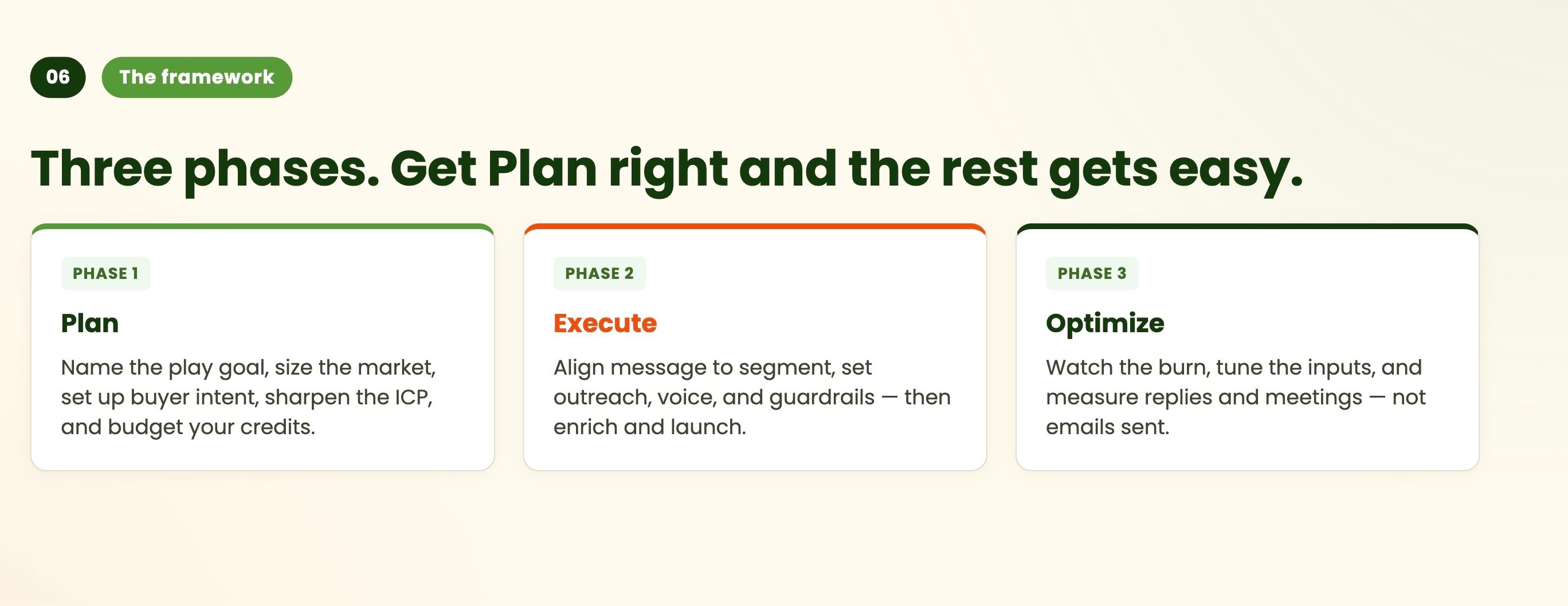
A slide from our webinar going through the three phases of setting up Prospecting Agent + Apollo
The three-phase approach to on-target, on-budget plays
We learned to tackle our playbooks in three phases, in order.
1. Plan.
- Name the play type first. Are you working a known list, or surfacing net-new? These are two different plays. Don't mix them.
- Size the market against your credit budget. The Kit's HubSpot Credit Calculator tab turns a monthly lead target into a dollar figure. For an "Expected" scenario (40 accounts enrolled, 1.5 contacts surfaced per company), you're looking at about $30 per month in overage on the Professional plan.
- Sharpen the ICP into segments and personas before the Agent ever sees them.
2. Execute.
- Set selling context at the segment level. One selling context per segment, applied consistently across every play the segment runs.
- Choose sequences or adaptive outreach based on how multi-channel your motion is. Adaptive is email-only. Sequences let you layer LinkedIn, calls, and tasks.
- Set brand voice and guardrails once, at the play level.
3. Optimize.
- Run the Week-1 review inside HubSpot, then weekly after that.
- Watch credit burn against your target.
- Measure replies, meetings, and cost per meeting. Not emails sent.
The Prospecting Agent Planning Kit is a Google Sheet we created because we needed something concrete to put in a rep's hands before they launch a play.
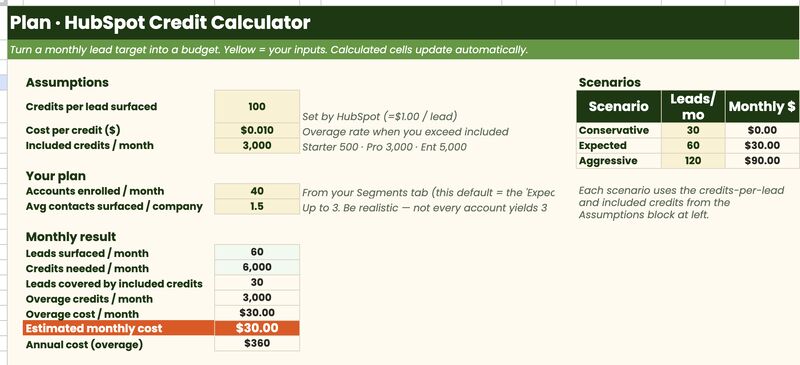
Get your own copy of the Prospecting Agent Planning Kit here →
The Kit sizes the inputs you bring to HubSpot before you ever touch the Agent. That planning work is the difference between running the Agent on budget and spending several times that when you skip the sizing step.
What actually worked
Three tactics moved the number for us.
Play type: Salesforce Integration Outreach.
We built a play for net-new companies running Salesforce that also fit our HubSpot ICP. Krystina's read on it, from Slack:
"IDK what sprinkle fairy dust magic you put on the Salesforce Integration v2 Outreach play, but so far, it has the best email copy and selling context. Minimal edits per email. Super relevant and quick to enroll contacts."
The magic was tight selling context. We fed the Agent a specific piece of Growth content — a blog post explaining a recent HubSpot-Salesforce integration change. The Agent used that to write emails to accounts already running Salesforce. Sharper input, sharper output.
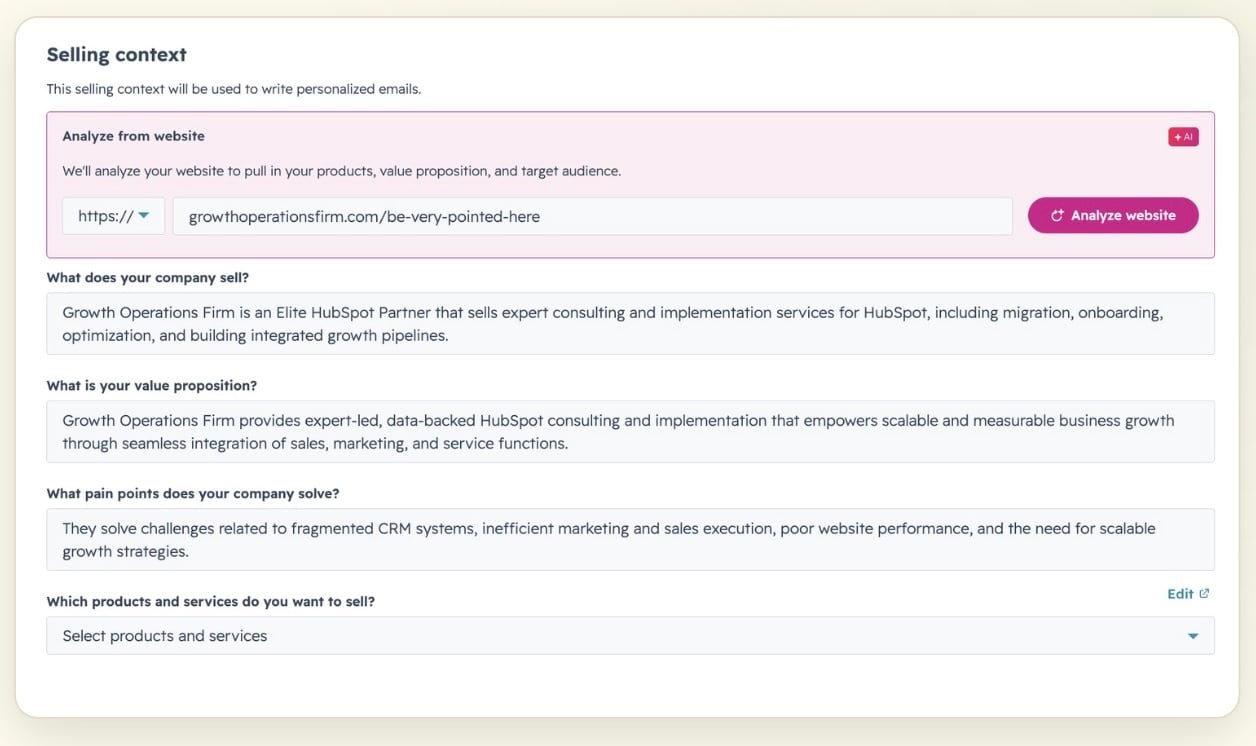
When the Agent doesn't have the contact you need, jump to Apollo.
The Prospecting Agent surfaced a 400-person org in our ICP, but with only one contact in our CRM: their Head of Enterprise Sales. We wanted to reach more contacts on the buying committee, given our play's focus.
What Krystina did:
- Went to Apollo, searched for lower-seniority sales directors and managers at the organization
- Found viable contacts
- Saved them to Apollo, pushed them to HubSpot
- Went back to the Prospecting Agent. They were now in "All CRM Contacts," ready to enroll in the play
This is the HubSpot + Apollo motion in miniature. The Agent surfaces the account. Apollo fills the persona gap. HubSpot runs the play.
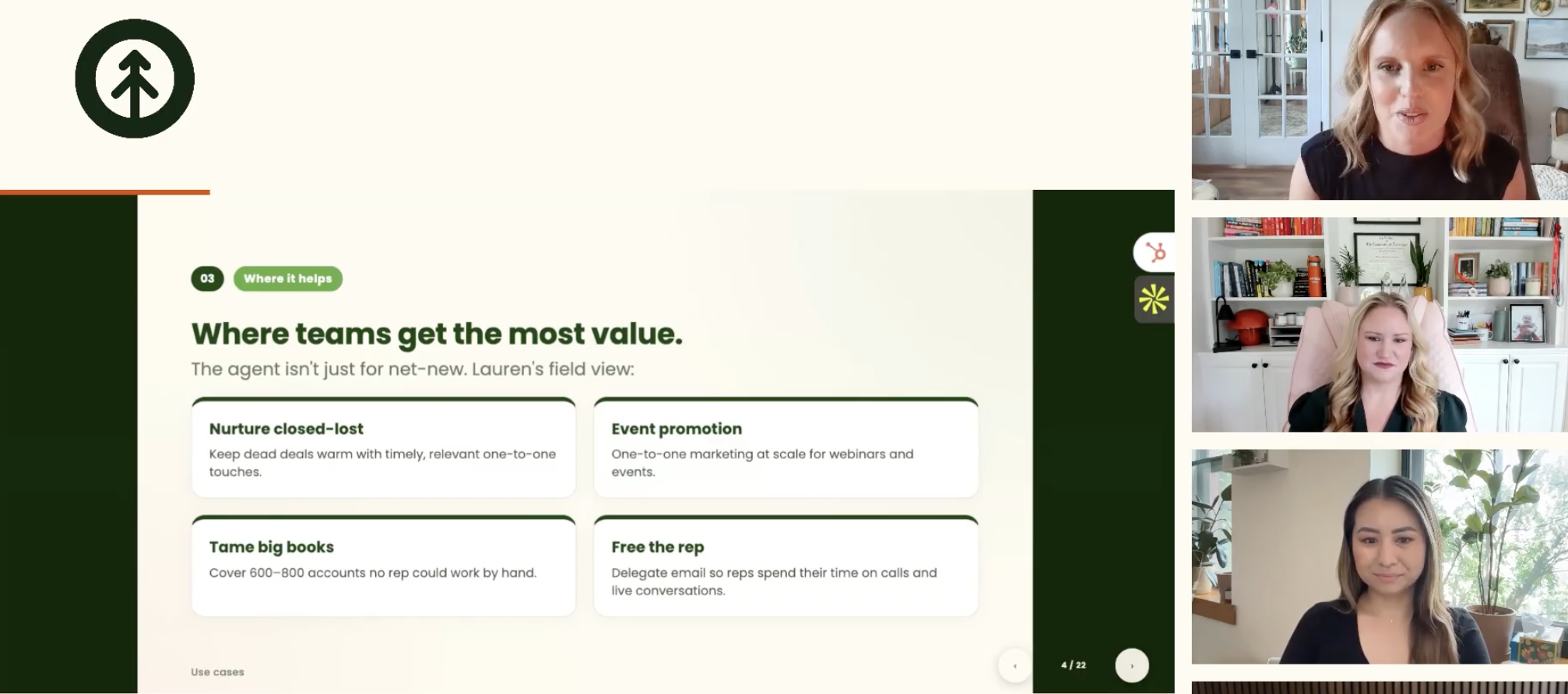
Me on our webinar with HubSpot and Apollo going over our top use-cases
Optimizing without over-managing
Optimization has been the least glamorous and most valuable phase.
What we watch daily:
- Where credits are getting consumed versus where meetings are getting booked
- Which signal-plus-message pairs are converting
- Whether reply sentiment is positive, neutral, or negative
- Bounces, spam complaints, opt-outs
What we prune weekly:
- Segments that trip too broadly (Apollo surfacing companies outside our ICP tiers)
- Personas that don't map cleanly to Agent behavior (the GTM Engineer example above)
- Plays that are burning credits without producing replies
We built three simple segments to prioritize sales nurturing after the webinar: fit-score tiers (low, medium, high), filtered by domain to exclude partner emails like HubSpot and Apollo. That's the filter that makes Krystina's follow-up manageable across hundreds of leads.
The framework Krystina wrote up early on, which we now use with clients:
AI and agents = intelligence + speed.
Sequences and tasks = execution + accountability.
Workflows = enrollment + governance.
The rep = judgment + final action.
Each role stays in its lane. The Agent handles surface and draft. Sequences carry the cadence. Workflows govern enrollment. The rep owns judgment and the final send.
The 90-day numbers
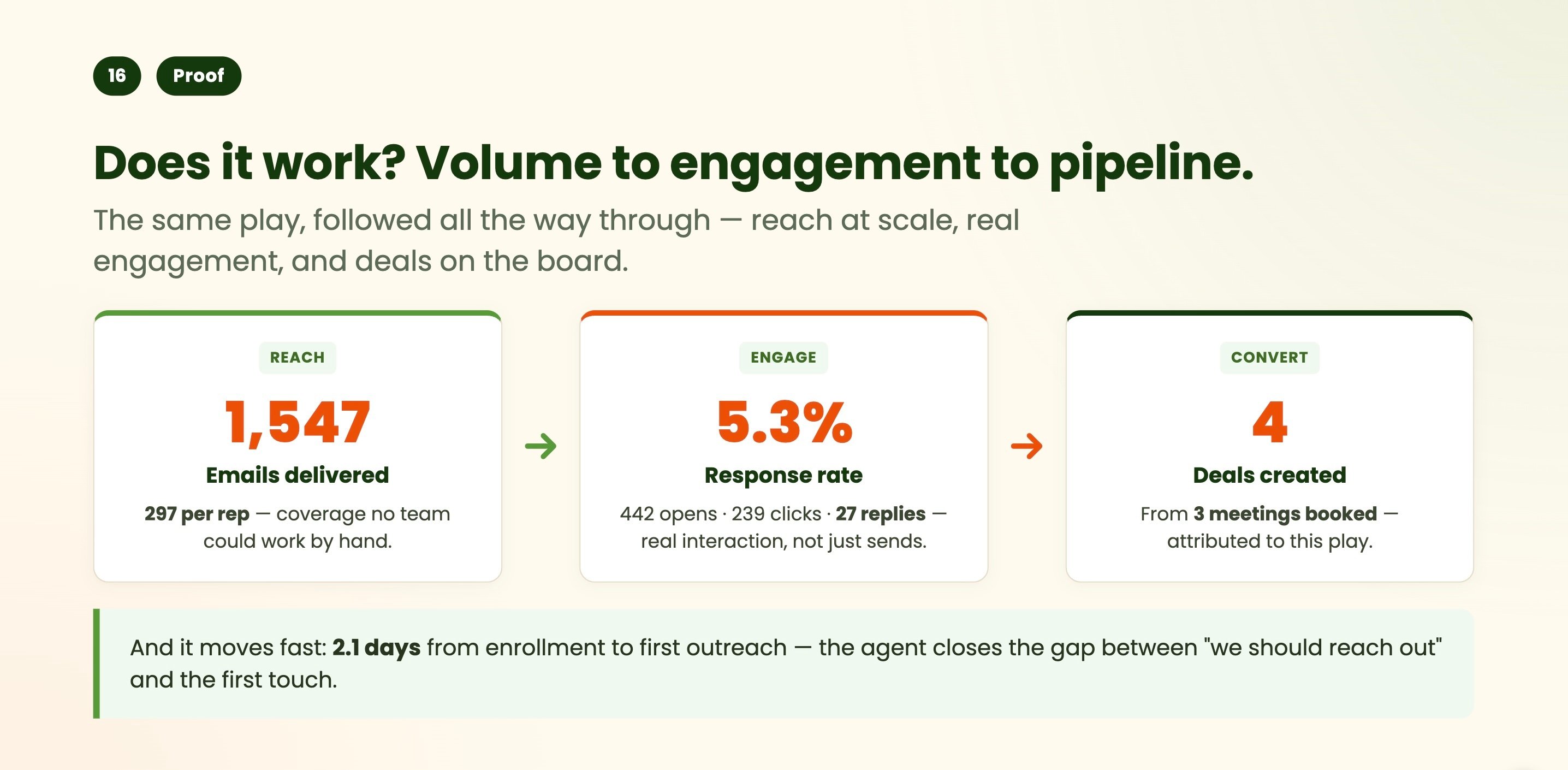
- ~300 emails per rep per cycle through the Prospecting Agent
- 5%+ reply rate, versus the 2–3% we'd expect from fully manual outreach
- Multiple deals sourced from Agent-driven touches
- Six to eight weeks of daily pruning to get there
Those are our initial numbers. Each team is different and you may have different benchmarks for your needs and goals. The most important thing is to build your plan and start executing so you can produce the data and insights you need to optimize over time.
The longer-term signal
Ninety days after we started, we ran a live webinar with HubSpot and Apollo on this exact topic. 604 people registered. Our original goal was 200.
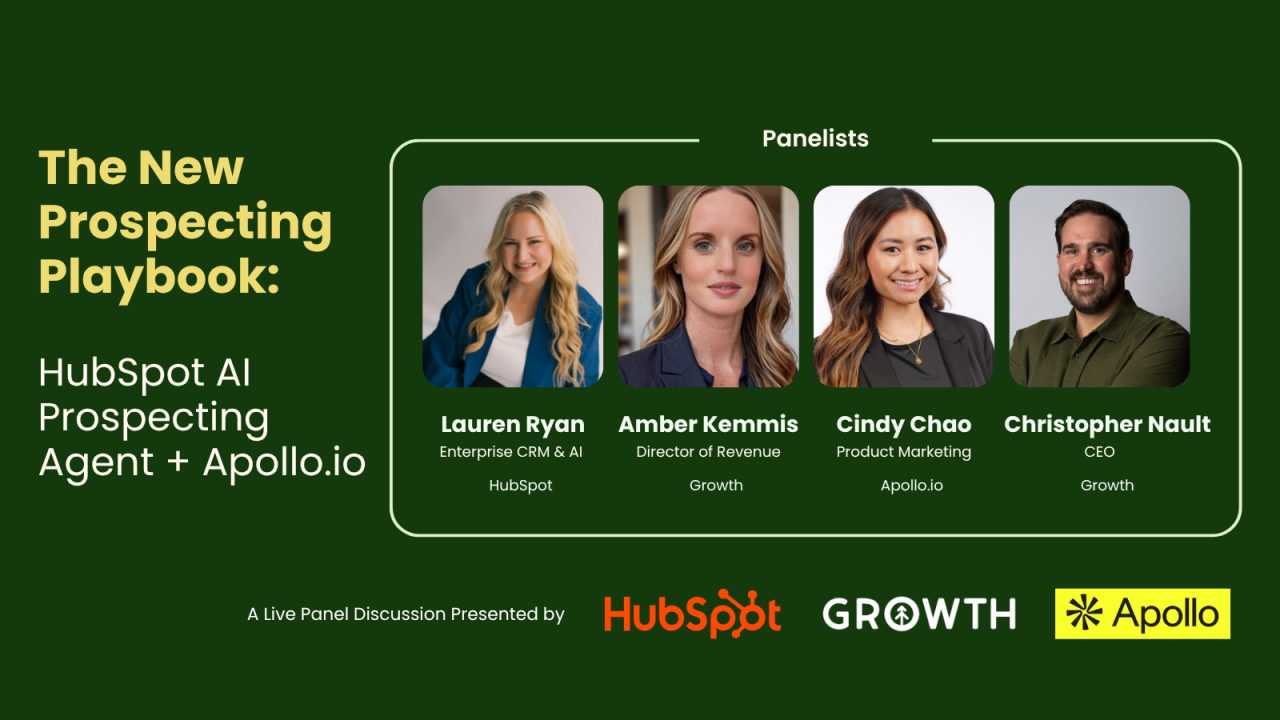
We used the Prospecting Agent to fill a webinar about the Prospecting Agent. The entire marketing motion for the event ran with Apollo data enriched into HubSpot, workflows we'd built during the 90-day rebuild, and the same play patterns we'd learned to trust.
The output from the webinar itself:
- Eight workshop bookings from the follow-up email alone
- First closed deal from the campaign on July 15 — a webinar attendee who booked the 1:1 workshop and converted to services
The Agent didn't book that deal. The Agent surfaced the right contact, at the right time, with enough context that the rep could do rep work. That's human in the loop.
Want us to help you ace your first 90 days?
If you're evaluating HubSpot's Prospecting Agent, or already running it and burning through credits faster than you're booking meetings, we run free 30-minute Solution Design Workshops for teams in exactly this situation. Krystina walks through your specific stack — HubSpot only, HubSpot + Apollo, HubSpot + ZoomInfo, something else — and fills in a version of the Planning Kit for your business, live on the call.