


35 Years to 30 Seconds: The Digital Transformation of Gateway for Cancer Research


Engineering a Modern Donor Engine
The Growth Operations Firm led a 16-week digital transformation centered on migrating GCR to a unified HubSpot environment. This wasn't a simple data lift; it was a complete architectural overhaul designed to respect GCR's 35-year history while modernizing their future.
A core pillar of the solution was the creation of a Custom Household Object. By moving away from the Salesforce "Household-as-Account" workaround, the Growth team engineered a structure that now supports over 100,000 records, allowing for precise association between multiple family members and their respective donation "deals". This solved a major pain point for the development team: the ability to generate formal and informal salutations and manage mailing-list logic for multi-contact households without duplicating records.
To eliminate the manual labor of data entry, GCR’s disconnected payment platform was replaced with a Custom HubSpot Donation Module. This module was built to allow one-time and monthly gifts—reflecting specific donation tiers like "a day of research"—to flow directly from the website into HubSpot Payments. This automatically populates the donation pipeline, creates the appropriate deal records, and assigns them to the correct fund without any manual intervention.
The Technical Deep Dive: Mapping 35 Years of Data
The technical heart of this project was the mapping of 700+ custom properties from the legacy Salesforce environment into HubSpot. The team encountered decades of historical anomalies, where donor association practices had changed multiple times since the early 90s.
The Growth team conducted a comprehensive data audit, identifying and mapping everything from "Wealth-X" dossiers and "WealthEngine" scores to event-specific attributes like "2025 Cures Gala Table Number".
Growth was able to migrate 256,324 total records with a 99.8% accuracy rate.
This process wasn't just about moving numbers; it was about normalizing data. Historical "Campaign" data from Salesforce was converted into searchable attributes on HubSpot Deals. This allows the GCR team to run revenue reports per event with a single click, a process that previously required at least 10 hours per month of spreadsheet manipulation.
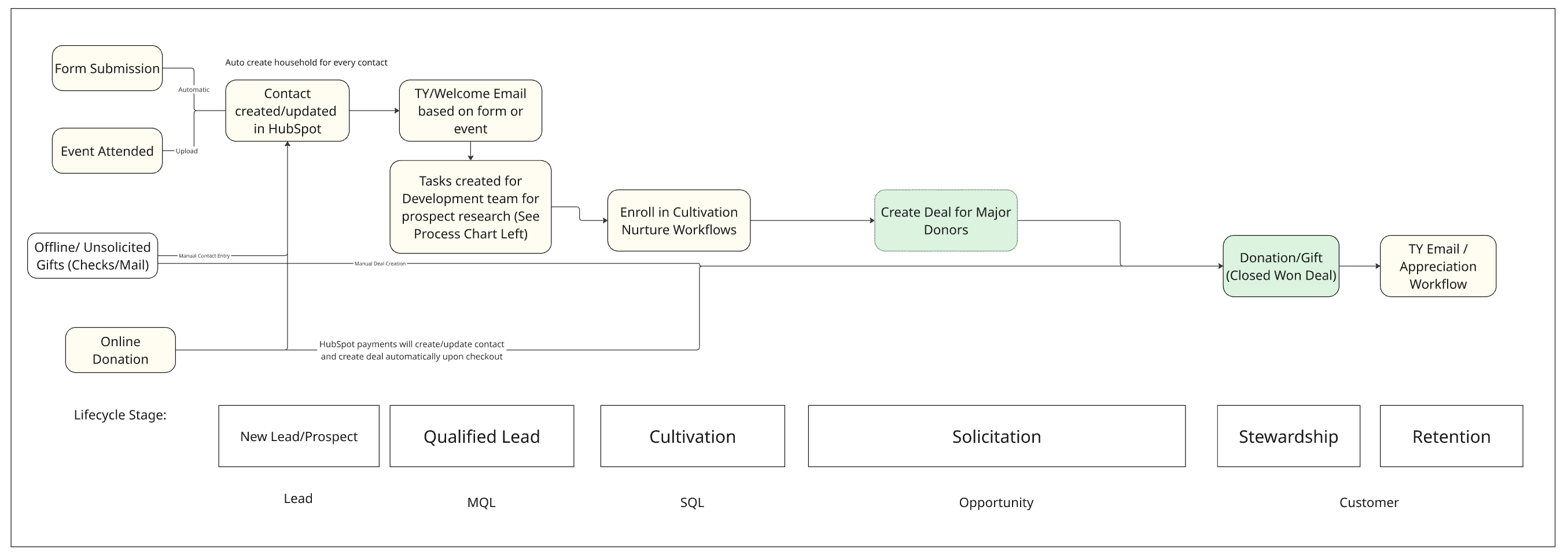
The Growth team also helped GCR define custom lifecycle stages in HubSpot to reflect the unique non-profit lifecycle, where prospects move from "Cultivation" to "Solicitation" to “Stewardship.”
Empowering a Lean Team with Breeze AI
 With the foundation in place, GCR turned to Breeze AI to act as a force multiplier for the lean team. The marketing department now utilizes Content Remix to instantly transform successful donor emails into multi-channel social media posts, maintaining a consistent brand voice across platforms without increasing headcount. This is particularly valuable as GCR moves toward more event-based and online fundraising.
Since the initial launch, GCR has further innovated by integrating SMS directly into HubSpot, using the system’s AI capabilities to convert long-form email narratives into high-impact text messages for urgent donor updates.
Even the follow-up process is AI-enhanced; the team uses system-generated notifications to identify "stalled deals" in the pipeline, prompting re-engagement before donor interest wanes.
From 0% to 100%: Measurable Impact
The results of this implementation represent a fundamental shift in GCR’s organizational health.
In the legacy system, activity logging was virtually non-existent because the platform was not user-friendly. Today, GCR has moved from "0 being logged" to 100% comprehensive logging of all calls, emails, and notes. Perhaps most importantly, the system is no longer a "one-man show." Adoption has jumped to 100% of the organization, with 8 out of 8 staff members who should be using HubSpot now using it as a daily tool.
For a team working across different states, HubSpot has become the "unifying performance tool" that allows everyone to see the full, 35-year history of a donor in a single, clear view. Reporting that once required 10 hours a month of manual spreadsheet reconciliation is now automated through custom dashboards, providing GCR with real-time confidence in their data and the ability to attribute every dollar raised to the specific campaign that inspired it.
Gateway for Cancer Research is no longer just storing data; they are using it to fund the future of cancer research.